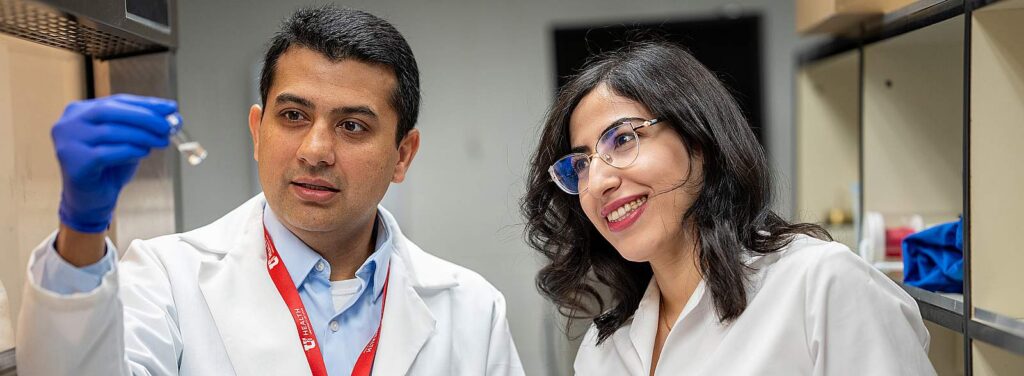
From uncovering the genetic drivers of heart disease to developing next-generation therapies, today’s biomedical research is opening new possibilities for patients with previously untreatable conditions. In this section, we highlight groundbreaking studies and collaborative discoveries in cardiovascular science, gene therapy, and regenerative medicine, including innovative approaches designed to restore cardiac function, improve recovery, and advance the future of precision healthcare.
Physiological Pacing
For decades, conventional right ventricular (RV) pacing was the standard. However, because RV pacing stimulates the heart muscle in a pattern different than normal cardiac activation, it creates a delay between the right and left sides of the heart (dyssynchrony), which can eventually weaken the heart muscle. The primary advantage of conduction system pacing is that it utilizes the normal activation sequence of the heart and maintains synchrony and rapid activation of the whole heart. We seek to develop pacing leads that interface the conduction system and facilitate the placement and stability of these leads. Our lab has investigated the beneficial effects of physiological pacing and developed new technology facilitate consistent lead placement.
Antitachycardia Pacing
Patients at high risk for ventricular arrythmias may receive an implantable cardioverter defibrillator (ICD), which can detect and treat arrythmias with shocks or pacing. ICDs can deliver antitachycardia pacing (ATP), a series of critically timed pulses that can break up sustained arrhythmias and return the heart to normal sinus rhythm. We have demonstrated that ATP delivered to the conduction system is safer and more effective than ATP delivered to the traditional location in the right ventricle. We are continuing to improve device therapy by developing simulations of the heart with inducible ventricular tachycardia to further optimize ATP delivery to the conduction system.
Gene Therapy For Heart Failure
We have partnered with other labs at CVRTI to test a novel gene therapy for ischemic heart failure. The protein cardiac bridging integrator 1 (cBIN1) is responsible for organizing the T-tubules and calcium-handling machinery essential for heart contraction. In failing hearts, cBIN1 is often reduced, leading to structural and electrical instability. The treatment was shown to reverse disease progression, significantly improving cardiac muscle function and overall survival rates. Ongoing studies seek to quantify the effect of cBIN1 gene therapy on arrhythmic burden in a relevant preclinical model.

Research Areas
Simultaneously, we published structure-function studies focused on the impact of mechanical unloading on reverse remodeling and myocardial recovery that are bringing our scientific progress in myocardial recovery from bench to bedside. Along these lines the UCAR program was a leader in the bridge-to-recovery multicenter study RESTAGE-HF which is considered widely as a turning point for the myocardial recovery field.
UCAR was supported over the years by extramural funding through the NIH, AHA, Dpt of Veterans Affairs, European Union, Doris Duke Foundation, Nora Eccles Treadwell Foundation, Intermountain Research Medical Foundation and others.
Molecular Mechanisms in Heart Failure, Reverse Remodeling and Myocardial Recovery
Ischemia-reperfusion and cardiogenic shock
Myocardial and Vascular Metabolism
Graft structure-function and coronary allograft vasculopathy
Leadership in Myocardial Recovery
Dr. Dosdall co-chaired the NHLBI Working Group on Myocardial Recovery – its members list and executive summary can be found at: https://www.nhlbi.nih.gov/events/2016/nhlbi-working-group-advancing-science-myocardial-recovery-mechanical-circulatory. The white paper was simultaneously published at flagship journals of associated biomedical societies: J Am Coll Cardiol: Basic Transl Sci, J Card Fail, ASAIO J, J Thor Cardiovasc Surg (PMID28736756).
To facilitate progress in the field of myocardial recovery we have been co-organizing for the last 12 years the annual international Utah Cardiac Recovery Symposium (UCARS – https://medicine.utah.edu/internal-medicine/cardiacrecoverysymposium) which features original clinical, translational and basic science research.
Commitment to Mentorship
Dr Dosdall has a strong commitment to mentoring the next generation of scientists and physician-scientists. In 2021, he was presented the inaugural Guy Zimmerman Faculty Mentorship Award, University of Utah School of Medicine and in 2017 he was the sole recipient of the Department of Medicine Faculty Mentorship Award. More than 70 publications were authored by trainees or junior faculty under his mentorship and many of them were supported by competitive career development training grants.
Nine of his mentees have moved on to independent faculty positions with >50% research time. Since 2017, he has been the PI of the NHLBI Cardiovascular T32 grant and previously he had served for several years on the executive committee of this grant. He also served as the Director and PI of an American Heart Association-funded Institutional Undergraduate Student Research Fellowship Program for performing cardiovascular research at the U of Utah.